The Failure Rate and the Vision Arrived in the Same Season
40%+
of agentic AI projects forecast to be canceled by end of 2027
Gartner · June 2025
95%
of enterprise GenAI pilots with no measurable P&L impact
MIT NANDA · 2025
10%
have redesigned even one end-to-end workflow
The Symbiotic Enterprise · 2026
~0%
operate as an agentic organization
The Symbiotic Enterprise · 2026
If you hold responsibility for an agentic AI program, the numbers you have probably been reading are uncomfortable. The vision arrived in the same season as the failure rate, and it does not account for it.
Gartner forecasts that more than 40 percent of agentic AI projects will be canceled by the end of 2027, and it names the causes as escalating cost, unclear business value, and inadequate risk controls (Gartner, 2025). MIT NANDA's research on enterprise generative AI found that roughly 95 percent of pilots produced no measurable profit-and-loss impact, and attributed the failures to integration and organizational learning gaps. The GenAI models were not the source (Challapally et al., 2025).
Boards have noticed. The two questions they now put to the executive sponsor of every agentic program are simple to ask and hard to answer. What is the defensible economic value this program returns for the compute it consumes? And what does it cost the enterprise the first time an agent commits something to production autonomously and is wrong? Neither question is answered by lagging indicators that tell you what was spent on AI compute costs, etc., which is what most current programs have on hand. Both questions have known answers in the operating-model literature that predates agentic AI, from throughput accounting to model-risk management. Outcome-Owned Architecture is our answer for the agentic case. It re-derives the operating model from the decision loop up, with a defensible economic figure at the funding boundary of every loop and a priced risk term at the boundary of every autonomous commitment. A portfolio of AI use cases stapled to an org chart carries neither.
Into the lazy season of summer vacations arrived The Symbiotic Enterprise (Jansen et al., 2026, hereafter TSE), published by QuantumBlack, AI by McKinsey in June 2026. TSE deserves a fair reading as a marketing vision, and parts of it are genuinely valuable. Its survey evidence is, from our research, the strongest public documentation of the augmentation trap: by its numbers, roughly 80 percent of organizations run GenAI chatbots, about 60 percent automate tasks inside existing workflows, around 10 percent have redesigned even one end-to-end workflow, and effectively zero operate as what it might call an agentic organization. Its synthesis of physical AI is useful.
And its central premise is one Jamie Bernard and I have argued for years: the enterprise operating model is obsolete, because the four constraints that defined and shaped the OpModel are now challenged by agentic capabilities. Information arrived in batches, coordination was expensive, execution required human hands, and decisions were at the mercy of coordinated calendars and queues. None of those constraints hold anymore, and a structure derived from dead constraints can't be optimized into fitness. On the premise, we and TSE agree. Our own account of that premise, together with the method built on it, is stated in full in Outcome-Owned Architecture (Bernard & Evans, 2026, hereafter the OOA whitepaper).
Where the Disagreement Begins
The disagreement concerns everything after the premise. TSE describes a destination and offers no route: no unit of analysis below the operational domain, no decision policy for allocating specific work, no priced risk term, no funding boundary, no accountability architecture, and no prediction stated in a form that could fail. Those absences are what make up the hard part of this equation.
TSE rests on eight assumptions, and each one fails a test that the operations science of execution, the Theory of Constraints and the economics of flow, wrote decades before TSE was drafted. This essay walks through the eight, one at a time, with citations. Every claim about TSE is checkable against the published document, and the final section states what evidence would refute this critique, because we hold ourselves to the standard we are applying.
I
Assumption One
A Percentage of Automatable Hours Tells You Where the Money Is Lost.
TSE's urgency rests on the claim that close to 60 percent of work hours are now theoretically automatable, drawing on McKinsey Global Institute research. The estimate's history recommends caution. MGI placed roughly half of activity hours in the automatable category in 2017, stated in 2023 that generative AI could automate activities absorbing up to 70 percent of employee time, and published 57 percent in late 2025, a figure trade commentary noted had nearly doubled the two-year-old estimate (MGI, 2017; MGI, 2023; MGI, 2025). TSE's own footnote concedes the figure includes capabilities demonstrated only under laboratory conditions, and MGI has consistently cautioned against reading these numbers as adoption forecasts. An estimate that fluctuates this much between releases is tracking the pace of capability announcements and carries no information about any specific enterprise's work.
Operations science explains why the number could never carry that information, even if it held still, and Section 2 of the whitepaper grounds OOA most deeply in the two traditions that make the objection. A system's output is governed by its binding constraint, and improving anything else is local optimization that moves no throughput. This is the critical insight of the Theory of Constraints, the operations discipline the physicist Eliyahu Goldratt designed out of factory-floor work in the 1980s and established in The Goal.
"An hour lost at the bottleneck is an hour lost for the entire system."
Eliyahu Goldratt & Jeff Cox · The Goal · 1984
An automatability percentage counts hours of touch work across the whole system without asking where the constraint resides. The critique from Don Reinertsen's flow perspective provides a sharper objection. In knowledge work, lead time is dominated by the time work spends waiting between activities, and the value-adding touch time is a small fraction of the elapsed whole. The gap between resource efficiency and flow efficiency is the codified name for it in This Is Lean, the field study across service and manufacturing settings by Niklas Modig and Pär Åhlström (Modig & Åhlström, 2012). The queueing economics beneath the pattern live in Donald Reinertsen's Principles of Product Development Flow, which traced the same wait to the invisible queues between product-development activities (Reinertsen, 2009). Automating touch time attacks the small share of total lead time while leaving the queues intact, and queueing behavior predicts the consequence: faster arrivals into unchanged batch and approval structures lengthen the very waits that dominate the outcome.
The Category Error
A 60 percent figure is a resource-efficiency number offered as the answer to a flow-economics problem. What an executive needs before committing capital is a measurement of where their enterprise's lead time demonstrably and provably goes, decision by decision, which is a trace.
OOA was built against this class of claim. The evidence discipline of Section 7.3 of the whitepaper holds that theoretical potential is inadmissible as value: every value figure in the Outcome-Earned Economic Model, the compute-yield allocation ρ = V / (C + R) specified in Section 4.6 and Appendix D of the whitepaper, must trace to a baseline observation under the value-attribution discipline. Appendix D.1 states the rule at the formula level: any value that can't be attributed is recorded as unattributable, and narrative allocation is refused. Section 4.1 of the whitepaper instruments that trace on stalls, swivels, and batch boundaries per loop because the enterprise's lead time lives in the waiting, and a trace is what no percentage can substitute for.
II
Assumption Two
The Exemplars Generalize.
TSE's evidence for step-change gains is a small set of cases. The two strongest quantified claims, a 40 percent productivity improvement at an unnamed financial services firm and a near 50 percent cost reduction at an unnamed European utility, are cited to Rewired, a book written by McKinsey's own partners (Lamarre et al., 2026). TSE's most important numbers therefore cite the authors citing themselves, with no independent verification, no published baseline, and no stated measurement method. The named cases carry a different limitation, one TSE itself concedes: Amazon and Ocado operate purpose-built fulfillment environments engineered from the ground up for machine execution, and most physical environments are nothing like them. The Renault humanoid case is presented as evidence of disruptive gains in progress, and independent reporting describes a single-task pilot, tire handling at the Douai plant, restricted by speed and dexterity, with roughly ten robots planned for the end of 2026 and the widely quoted 350-unit figure standing as a strategy-day ambition for 2027 (L'Usine Nouvelle, 2026; The Robot Report, 2026).
Read through the operations-science lens Section 2 of the whitepaper grounds OOA in, the successful exemplars succeed for a reason TSE never names. Amazon and Ocado are systems in which batch structure was collapsed and the entire facility was subordinated to continuous flow, which is Goldratt's subordination step and Reinertsen's batch-size economics executed at building scale (Goldratt & Cox, 1984; Reinertsen, 2009), available in greenfield environments because no inherited structure was present to defend itself. TSE attributes the outcome to AI capability when the causal mechanism visible in its own cases is flow redesign with AI as the enabling technology. The measurement signature points the same way. Every reported gain is a resource-efficiency percentage, faster processing and higher productivity, with no lead-time accounting and no delay economics, so a reader can't determine whether throughput at any system constraint moved at all.
The Precedent
Business Process Reengineering arrived in the early 1990s with the same architecture: a correct diagnosis, an urgent headline figure, dramatic exemplars, and no instrumented baselines (Hammer, 1990; Hammer & Champy, 1993). Its implementation record is the cautionary chapter of every operations curriculum since.
Section 2 of the whitepaper states the three departures OOA makes from that precedent so the same mistake is not repeated: the decision loop replaces the process as the unit of analysis, human judgment loops are designed as first-class outputs, and un-instrumented redesign is replaced by a measured trace with bounded, pre-registered predictions. Those pre-registered predictions are the operational content of the collapse metrics of Section 7.2, which require that for each trace metric the re-derivation state a predicted post-design value with bounds before deployment, and of the Phase 2 exit criterion of Section 5, which makes the pre-registration the condition for completing the design. A design that states its predictions in advance can be proven wrong by measurement, which is stated formally in Hypothesis H2 in Section 11.1.
Evidence that can't fail is marketing.
ForesightOps · Fugue Strategy Advisors
The corrective action needed is procedural: baselines must be measured before design, and predicted values with bounds recorded before deployment, so the design can be proven wrong by measurement.
III
Assumption Three
Respective Strengths Can Allocate Work.
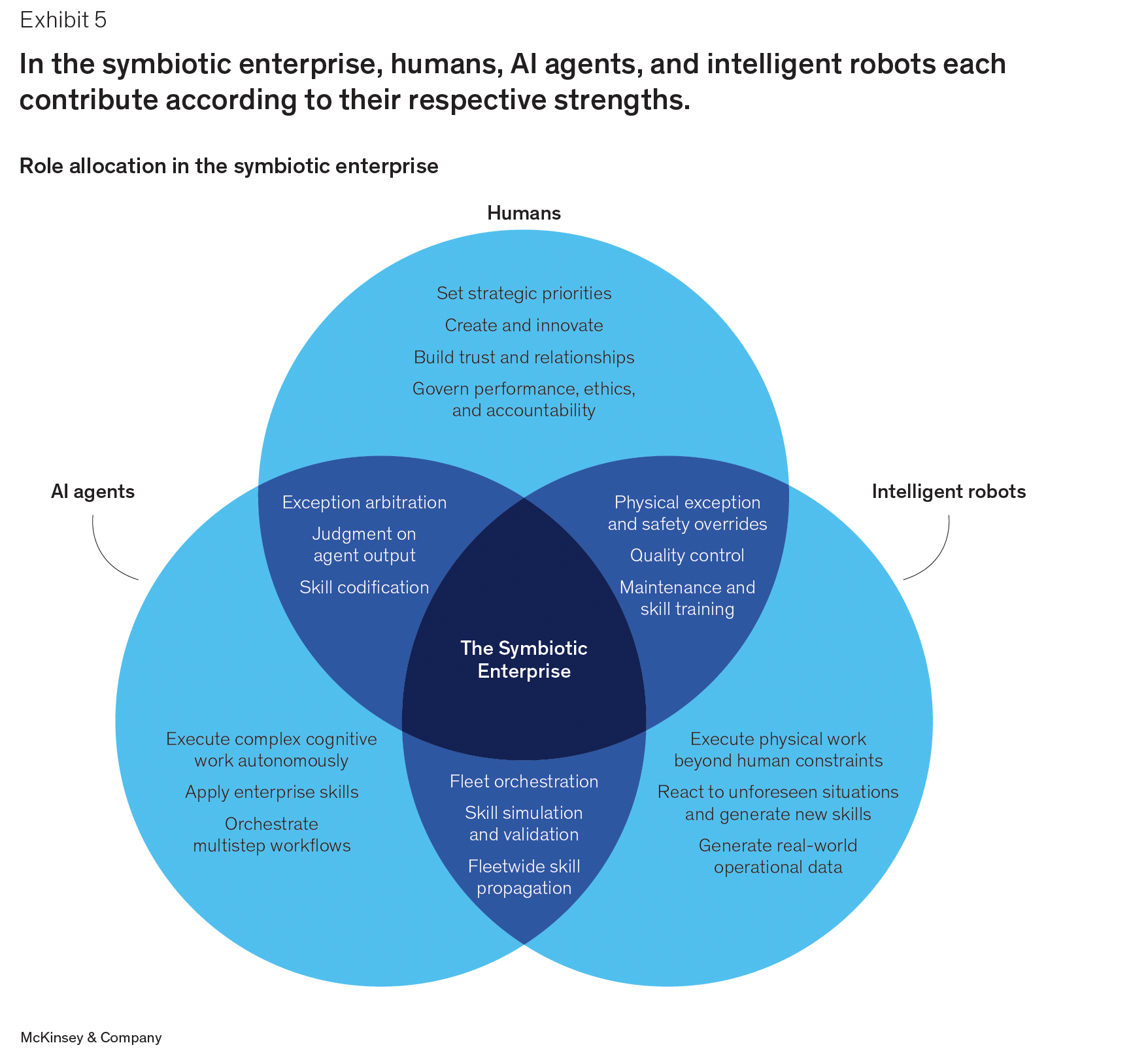
The center of TSE's target model is a diagram in which humans, AI agents, and intelligent robots each contribute according to their respective strengths: human judgment and exception handling sit with people, scalable cognitive execution sits with agents, and physical work beyond human constraints sits with robots.
These are descriptions of what each group is generally good at, and a general description can't place one specific decision. Hand the framework a single recurring commitment from a real operation to the authors and ask them which side of the human-machine line it falls on and why. TSE contains no knowability test, no instrumentability criterion, no economic threshold, and no classification procedure of any kind. The failure data suggests this is where programs die: all three of Gartner's named cancellation causes, cost, value, and risk controls, are allocation and governance failures, and model capability appears nowhere on the list (Gartner, 2025).
The Theory of Constraints diagnosed this design instinct in its founding text. Distributing capacity by capability, everywhere at once, with no constraint identified, is the balanced plant, and The Goal was written to demonstrate that dependent events combined with statistical fluctuation convert a balanced design into cascading delay (Goldratt & Cox, 1984). The five focusing steps put the sequence in its correct order: identify the constraint first, exploit it, subordinate everything else to it, elevate it only when it is genuinely the limit, and repeat without letting inertia set in. Allocation falls out of that sequence as a consequence, and TSE begins with allocation, which reverses the order.
Reinertsen states the complementary requirement from the economic side: decentralized decisions work only when the people and systems making them hold decision rules denominated in a common economic currency (Reinertsen, 2009). The sound basis for the human-machine line itself is knowability, the distinction between ordered domains where cause and effect are knowable and a rule can run, and unordered domains, where the response is to sense and probe. That is the Cynefin distinction, the complexity-and-decision framework Dave Snowden developed at IBM and formalized with Mary Boone in Harvard Business Review, which sorts decisions by how knowable their cause-and-effect structure is (Snowden & Boone, 2007). Paired with it is the decision-rights principle from organizational economics, that authority belongs where the requisite knowledge lives, the specific-versus-general knowledge distinction Michael Jensen and William Meckling formalized (Jensen & Meckling, 1992).
The Human-Loop Taxonomy
Section 4.4 of the whitepaper classifies all designed human judgment into three loop classes: the Policy Loop, which owns the rules that govern the agents, thresholds, watchlists, budget lines, and boundary parameters; the Trade-off Loop, which owns commitments whose decision variable the policy can't, or shouldn't, settle; and the Meaning Loop, which owns the interpretation of patterns across loop instances. The claim that these three classes are exhaustive is held falsifiable as Hypothesis H3 in Section 11.1, and any hand-up that resists classification is recorded as a taxonomy counterexample. Narrative absorption is refused.
The knowability axis lives inside Section 4.4 as the rule for where a loop may run, and the compute-yield ranking of Section 4.6 and Appendix D of the whitepaper is the economic rule for whether it should be funded, against a bounded compute budget with a shadow-sm price on the best unfunded loop.
A category is a description. A decision needs a rule, and the rule needs a theory.
ForesightOps · Fugue Strategy Advisors
IV
Assumption Four
Managing AI Cost Is Managing AI Economics.
TSE's economics chapter observes that technology becomes a dominant, usage-driven component of enterprise cost and prescribes a discipline resembling FinOps: monitor token consumption, route across models, cache, compress, and optimize inference cost. All of it is sensible, and all of it is accounting. Cost management tunes a portfolio that someone has already chosen. It can't choose the portfolio. Nothing in TSE ranks candidate workloads, prices the risk of autonomous commitment, sets a funding boundary against a bounded budget, or derives the workforce from where that boundary falls. The word risk appears in its economics discussion only as a governance abstraction, never as a priced term, which means the framework can't distinguish two workloads of equal value where one is dangerous when wrong and the other is trivially recoverable.
This is the oldest argument in the Theory of Constraints, replayed with tokens in place of unit costs. Goldratt's throughput accounting begins from a bounded constraint and asks which portfolio of work maximizes value through it. Cost accounting begins from the ledger and asks how to make each unit cheaper, and his body of work documents how a diligently answered second question defeats the first (Goldratt & Cox, 1984). Reinertsen's version of the same critique concerns proxy variables: organizations measure what is easy to measure, cost and utilization, while the economically decisive variables go unpriced.
"If you only quantify one thing, quantify the cost of delay."
Donald Reinertsen · Principles of Product Development Flow · 2009
An enterprise optimizing inference cost with no priced delay and no priced risk will make locally cheap and globally expensive choices, and it will do so with excellent dashboards.
Section 2 of the whitepaper names throughput accounting as the direct lineage of the Outcome-Earned Economic Model, and Section 4.6 with Appendix D specifies the model itself: ρ = V / (C + R), value per unit of risk-adjusted cost. Appendix D.3 builds R per loop as the expected annual cost of the loop's autonomous commitments being wrong, along a control axis, rule-bounded versus true-judgment commitment, and a nature axis, transactional versus informational commitment. There is no equivalent of R anywhere in TSE, so its framework can't price the danger of being wrong at all.
The Funding Boundary
The compute budget is the constraint, loops are funded in descending ρ until the budget line, and the shadow-sm price of the best unfunded loop states in one number what an additional unit of budget would buy, which is the number the Policy Loop carries into the budget argument. Section 4.7 records the whole thing as the yield ledger, the fifth item in the operating-model definition, so classifications carry a reviewable rationale. TSE's economics chapter contains no ledger, no ranking, no budget line, and no shadow-sm price.
V
Assumption Five
The Flattening Happens This Time.
TSE predicts organizational flattening as coordination layers consolidate, concedes that flattening predictions have a long record of failing to materialize, and argues this wave differs because agents replace coordination functions directly. The concession is more persuasive than the rebuttal. Section 3.4 of the whitepaper states the mechanism. Organizational structures survive the loss of their function. Coordination layers retain constituencies, performance metrics, cadences, and professional identities long after the constraint that justified them has disappeared, and local optimization preserves them because each is locally rational to keep.
The binding constraints of mature organizations are policy constraints, and a policy constraint does not dissolve when capacity arrives. It must be identified and deliberately removed, with the standing warning that inertia converts yesterday's solution into today's constraint. That is the later movement of Goldratt's own work, developed in Critical Chain a decade after The Goal (Goldratt & Cox, 1984; Goldratt, 1997). Coordination layers and approval gates are policy constraints with constituencies, metrics, and identities. Critical Chain adds the mechanism by which hierarchy accumulates its bulk: safety embeds at every level, each layer adding its own buffer, review, and margin, so the structure grows by locally rational increments that no local actor has the authority to remove (Goldratt, 1997).
Install agent capacity beneath unchanged approval policies and queueing arithmetic predicts the observable result. Agents raise the arrival rate of work into the surviving human approval gates, queue length grows non-linearly as utilization at those gates climbs, a behavior Reinertsen spent two chapters teaching product developers to respect (Reinertsen, 2009), and the enterprise experiences faster work production feeding longer decision waits. That prediction matches TSE's own survey: near-universal deployment, near-zero transformation, incremental gains.
Conway's Law
The shape of the failure has a name in software architecture. Systems tend to mirror the communication structures of the organizations that build them, the observation Melvin Conway published in 1968 that carries his name still (Conway, 1968), so agents deployed along the org chart entrench the org chart.
TSE's account of why hierarchy exists is also incomplete. It grounds traditional organization in two structural constraints: the need to distribute specialized expertise and the need to coordinate across functions. Section 3.3 of the whitepaper derives the inherited operating model from four foundation assumptions: information arriving in batches, expensive coordination, human-dependent execution, and time-rationed decisions. TSE's two constraints are a subset of our four, and the two it omits are consequential. Because TSE never identifies decision cadence as a constraint, its claim of continuous adaptability in the target state arrives as an asserted benefit with no derivation behind it. Flattening arrives only as the consequence of removing policy constraints one at a time under the forcing-reason audit of Section 10.1, which requires every structure in the derived flow to carry a recorded force, either the loop itself or a declared seam, and fails any structure whose recorded force is current practice. Adding capacity, which is the only mechanism TSE offers, leaves the layers standing.
VI
Assumption Six
Governance Can Be Mastered as a Discipline.
TSE lists behavioral governance and security among five disciplines an enterprise must master, gives it roughly a paragraph, and moves on. The paragraph contains no accountability architecture: no answer to who owns an autonomous commitment that goes wrong, no declaration of what an agent will refuse to decide, no rule preventing a machine from laundering a commitment through a pro-forma human approval, no reversion path, no provenance requirement. The regulatory tradition that governs systems that decide, the model-risk grammar of validation before deployment, ongoing monitoring, drift detection, and effective challenge, goes unmentioned (Board of Governors, 2011). Gartner's third named cancellation cause is inadequate risk controls, so the market is already collecting on this omission (Gartner, 2025).
Section 2 of the whitepaper locates governance in the constraint tradition. Once agents absorb the knowable work, the binding constraint migrates to the point where human judgment ratifies machine output, and the five focusing steps generalize from the factory floor to that seam: identify the review point as the constraint, exploit it by sizing review to its real demand, and subordinate the agentic flow so knowable work paces to the seam and does not flood it (Goldratt & Cox, 1984). Governance without queue discipline fails in one of two directions. Starve the review point and it decays into rubber-stamping, oversight that reports success while exercising nothing. Flood it and the humans drown in escalations until the backlog forces exactly the shortcuts the review existed to prevent.
Figure 3 · What Happens at the Review Seam
Read the right-hand column downward. Arriving work triples and committed decisions do not move, because the seam still holds three slots. When one slot goes to triage, output falls to two. Pacing release to the seam returns it to three and holds the queue at zero.
Reinertsen's principle of decentralized control, economic decision rules installed at the point of best information (Reinertsen, 2009), describes what the architecture requires: typed hand-up conditions with service levels, owned thresholds, and a named human accountable for every loop.
The Judgment Boundary
Section 4.3 of the whitepaper defines the judgment boundary as a mandatory per-agent declaration of three things: what the agent will not decide, the precise hand-up conditions under which it pages a named human, and the form of that hand-up. A design in which any agent's boundary can't be stated is, by definition, incomplete. The boundary is asymmetric by construction: agents may always hand up and may never hand down, so no human can launder a judgment through an agent and no agent can launder a commitment through a pro-forma human approval.
Section 6.2 states the accountability rule: every loop has exactly one named human owner, and "the agent decided" is never an admissible account of any outcome. Sections 6.4 and 6.5 make provenance and reversibility mandatory: every commitment is logged and reportable, and every agentic loop ships with a rehearsed reversion path, giving the kill switch a defined operational state to revert to. The three-tier control catalog of Section 10, design-time, run-time, and periodic, extends the model-risk grammar from statistical models that score to autonomous agents that commit. The judgment-laundering failure mode of Section 12.1, in which the human loops decay into rubber stamps and the risk profile becomes that of full autonomy without the design for it, is what TSE's governance paragraph does nothing to prevent, and Section 7.4 specifies the health metrics that detect it: decision distribution, policy churn, and hand-up integrity.
Governance of that kind is designed before deployment. Governance the size of a paragraph is discovered in production, at the constraint, at full arrival rate.
ForesightOps · Fugue Strategy Advisors
VII
Assumption Seven
The Supply of Human Judgment Takes Care of Itself.
TSE's target state depends on humans exercising strategic thinking and seasoned human judgment above the agentic layer, and TSE names the threat to that dependency directly: apprenticeship pathways erode as junior analytical work automates, and without new mechanisms for developing human judgment and operational experience, organizations may face shortages of the experienced talent capable of governing autonomous systems. Having named the problem, TSE offers nothing for it and proceeds as if the supply can be assumed.
In constraint terms, TSE has identified the system's next binding constraint and proposed no elevation. Goldratt's discipline holds that elevating a constraint requires investment ahead of need, because capacity at the constraint carries the longest lead time (Goldratt & Cox, 1984; Goldratt, 1997), and human judgment carries the longest lead time of any capacity an enterprise builds, measured in years of formative work.
The science of that formation is specific. Expert human judgment is recognition-primed. The experienced person reads a situation as a pattern and commits, and the pattern library is built through accumulated exposure to real cases with real feedback. That is the naturalistic decision making tradition, the field research on firefighters, ICU nurses, and battlefield commanders that the cognitive scientist Gary Klein and colleagues built out of the 1980s and 1990s (Klein, 1998). Reinertsen's economics of fast feedback state the same mechanism from the flow side: learning is produced by feedback loops, and junior analytical work is the feedback loop through which professional human judgment develops (Reinertsen, 2009). Remove the work and you remove the loop.
Joint-Optimization Failure
The composite error has its own name in the sociotechnical tradition. Optimizing the technical system while the social system decays is joint-optimization failure, the founding finding of the field, from Eric Trist and Ken Bamforth's Tavistock Institute study of the mechanized longwall coal-mining method, whose technical gains collapsed once the self-regulating work groups were dismantled (Trist & Bamforth, 1951).
A target state that consumes a stock of human judgment it has arranged to stop replenishing is running down an asset it can't repurchase.
ForesightOps · Fugue Strategy Advisors
Section 4.3 of the whitepaper specifies where that judgment must sit in the re-derived structure, at the judgment boundary of each agentic loop, and Section 4.4 specifies what the judgment does: the Policy Loop owns the rules that govern the agents, the Trade-off Loop owns non-optimizable commitments where the numbers do not settle it, and the Meaning Loop owns the interpretation of patterns across instances. Section 7.4 specifies the health metrics that detect whether the judgment is being exercised or merely performed, with decision distribution and policy churn as the diagnostic pair, and with the override residual targeted at the designed rate. A zero-override rate is refused because it signals either perfect policy or disengaged judgment. The developmental question, how people cultivate the human judgment to stand at the boundaries an agentic operating model creates, is a discipline in its own right, and the elevation of that coming constraint has to be undertaken ahead of its migration.
VIII
Assumption Eight
The Operational Domain Is the Right Unit of Redesign.
TSE prescribes the operational domain as its unit of reinvention, naming product development, customer service, and order-to-cash. This assumption sits upstream of everything else in the document, and it is the one most directly contradicted by the science. Domains are artifacts of the old constraints: customer service exists as a bounded function partly because coordination was expensive and information arrived in batches, and order-to-cash exists as a named flow because the ledger was periodic. A redesign that takes the domain as its starting object imports the boundaries the obsolete constraints drew, then optimizes inside them, which is the same failure TSE diagnoses at the workflow level, operating one level higher.
The Structural Problem
A reader can be fully persuaded by TSE's destination and still possess no stable object to redesign, because every object TSE offers was shaped by the constraints the redesign is supposed to escape.
Goldratt's injunction is that the sum of local optima is never the optimum of the system, and a domain is a local frame by construction (Goldratt & Cox, 1984). Critical Chain makes the point structurally: the chain that governs a system's duration is defined by its dependencies, and dependencies do not respect departmental lines, so managing inside the lines manages the wrong object (Goldratt, 1997). Reinertsen's matching empirical observation is that the largest queues in knowledge work are invisible, carrying no inventory a manager can see on a floor, and they concentrate at organizational boundaries (Reinertsen, 2009), which is the territory a domain-scoped program leaves out of scope. The waits that dominate enterprise lead time form in the handoffs between functions, where a commitment queues for another team's approval, batch cycle, or calendar while the information required to decide already exists. A redesign scoped to one domain can never reach those waits, because they live at its edges.
The corrective is a unit of analysis that survives the redesign it enables. Section 3.2 of the whitepaper defines that unit as the decision loop, held fixed as a five-tuple ⟨τ, I, π, χ, φ⟩ of trigger, information set, policy, commitment, and feedback, while everything around it is allowed to change. The loop is foundation-invariant: some quantity of inventory will be committed to some location under any foundation, and only the shape of that commitment, its cadence, its information assembly, its authority, and its execution path is foundation-dependent. The sector-agnosticism claim is falsifiable, held as Hypothesis H1 in Section 11.1: the method applies to a decision loop in a second, unrelated domain with zero new primitives, and the claim fails if applying the method in a new domain forces the introduction of a new primitive. Section 4.1 instruments the trace along the loop, across every boundary the commitment crosses, which is why a trace can locate the binding wait and a domain-scoped program can't. Because TSE has no foundation-invariant unit, it can't state a falsifiable prediction about any specific redesign, and it makes none.
·
What the Eight Failures Share.
Two properties run through all eight, and both are checkable from the published document. The first is ordering. TSE's analysis proceeds from capability to organization: chapter one establishes what AI can do, chapter two presents capability exemplars, chapter three derives the target enterprise from the capability, and chapter four prescribes the transformation. At no point does an inventory of the enterprise's actual decisions appear. An analysis run in that order can recommend more automation, and it can never produce the recommendation against automating something, because the work was never enumerated on its own terms. Thirty pages therefore contain no example of a workload that should remain human on economic or risk grounds, and none that should be eliminated.
Figure 4 · The Five Focusing Steps, Read Against TSE
Elevating a constraint that was never identified is the failure mode the five focusing steps were written to prevent.
The second property is the reference base. TSE cites McKinsey Global Institute reports, McKinsey's own surveys, the authors' own book, vendor and press accounts of three deployments, and the Stanford AI Index. It cites no Goldratt, no Reinertsen, no Lean or value-stream sources, no queueing theory, no sociotechnical systems research, no decision-rights economics, and no Conway. The working vocabulary of that literature, constraint, queue, batch size, cost of delay, work in process, throughput, is absent from the text. A thirty-page document on reinventing enterprise execution engages none of the science of execution, and any reader with TSE and its reference list can verify the claim in five minutes.
The eight assumptions fail in the ways that science predicted because TSE was written as if the science does not exist.
ForesightOps · Fugue Strategy Advisors
·
The Standard Any Method Must Meet.
The standard this critique applies is five questions an executive can put to any operating-model method, this one and ours included.
Test One
Unit of Redesign
What is the unit, and does it survive the redesign it enables, or is it an artifact of the structure being replaced?
Test Two
Decision Rule
What rule places one specific piece of work on the human or machine side of the line, and from what theory does the rule derive?
Test Three
Priced Risk
Where is risk priced, in a bounded budget with a funding line, so that the economics can say no as well as yes?
Test Four
Negative Conclusions
Can the method produce a negative conclusion, and can it show one?
Test Five
Falsifiable Predictions
What are the predictions, stated with baselines and bounds before deployment, so that the design can fail in public?
Applied Symmetrically
To Our Work Too
Run the five questions against Outcome-Owned Architecture with the same severity applied here. That is what they are for.
We built Outcome-Owned Architecture and the Outcome Earned Economic Model to answer those five questions in writing: the recurring decision loop as the unit, a human-loop taxonomy grounded in knowability for the rule, ρ = V / (C + R) with a bounded budget and a shadow-sm price for the economics, a mandatory inverse test so the negative conclusion is exercised on every engagement, and pre-registered collapse metrics so every design carries its own falsifiers (Bernard & Evans, 2026). The OOA whitepaper states six hypotheses with measures and falsifiers, because a method that can't be proven wrong is a brochure.
·
Where This Critique Stands to Be Proven Wrong.
This assessment holds until specific evidence appears. It is refuted if a subsequent publication in this line presents a defined unit of analysis below the domain, an instrumented baseline protocol, predictions registered with bounds before deployment, a priced risk term inside a bounded budget, and at least one documented engagement in which a material workload was assigned to humans or eliminated on the method's own evidence. It is weakened if future work in this line engages the constraint and flow literature substantively.
The Commitment
We will acknowledge either development in public, because the point of this essay is the standard, and a standard that applies only to others is a posture.
What is the defensible economic value your agentic program returns for the compute it consumes? And what does it cost you the first time an agent commits something to production autonomously and is wrong?
If the answer to either question is a dashboard, the program has cost accounting where it needs an operating model. Outcome-Owned Architecture re-derives the operating model from the decision loop up, with a funding boundary on every loop and a priced risk term on every autonomous commitment.
Both figures appear here at reduced resolution and are reproduced solely for purposes of criticism, comment, and scholarly review under 17 U.S.C. § 107. Each is accompanied by substantive critical commentary in the body of this essay, and neither substitutes for the original publication, which readers are encouraged to obtain and read in full from McKinsey & Company.
Fugue Strategy Advisors and ForesightOps claim no ownership of these works and are not affiliated with, endorsed by, or sponsored by McKinsey & Company, QuantumBlack, or the authors of the cited report. Rights holders with questions about this use may contact Fugue Strategy Advisors directly.
Figures 3 and 4, the four-panel review-seam sequence and the five focusing steps scorecard, are original works of Fugue Strategy Advisors. The hero image is an original work of Fugue Strategy Advisors.
References
Bernard, J., & Evans, W. H. (2026). Outcome-Owned Architecture: A new physics of work (Working draft v1.7.1we). Fugue Strategy Advisors. foresightops.org
Board of Governors of the Federal Reserve System & Office of the Comptroller of the Currency. (2011). Supervisory guidance on model risk management (SR 11-7 / OCC 2011-12). federalreserve.gov
Challapally, A., Pease, C., Raskar, R., & Chari, P. (2025). The GenAI divide: State of AI in business 2025. MIT NANDA, MIT Media Lab.
Conway, M. E. (1968). How do committees invent? Datamation, 14(4), 28 to 31. melconway.com
Gartner. (2025, June 25). Gartner predicts over 40 percent of agentic AI projects will be canceled by end of 2027 [Press release]. gartner.com
Goldratt, E. M. (1997). Critical chain. North River Press.
Goldratt, E. M., & Cox, J. (1984). The goal: A process of ongoing improvement. North River Press.
Hammer, M. (1990). Reengineering work: Don't automate, obliterate. Harvard Business Review, 68(4). hbr.org
Hammer, M., & Champy, J. (1993). Reengineering the corporation. HarperBusiness.
Jansen, C., Chiarella, D., Baroudy, K., Hämäläinen, L., Van der Veken, L., Schaubroeck, R., Lacroix, S., Bout, S., & Dagorret, G. (2026, June). The symbiotic enterprise: How cognitive and physical AI are reinventing enterprise execution. QuantumBlack, AI by McKinsey.
Jensen, M. C., & Meckling, W. H. (1992). Specific and general knowledge, and organizational structure. In L. Werin & H. Wijkander (Eds.), Contract economics. Basil Blackwell. ssrn.com
Klein, G. A. (1998). Sources of power: How people make decisions. MIT Press.
Lamarre, E., Smaje, K., Levin, R., Singla, A., & Sukharevsky, A. (2026). Rewired: How leading companies win with technology and AI (2nd ed.). Wiley.
L'Usine Nouvelle, The Robot Report, and Humanoids Daily. (2025 to 2026). Reporting on the Renault and Wandercraft Calvin deployment at Douai.
McKinsey Global Institute. (2017, January). A future that works: Automation, employment, and productivity.
McKinsey Global Institute. (2023, June). The economic potential of generative AI: The next productivity frontier.
McKinsey Global Institute. (2025, November 25). Agents, robots, and us: Skill partnerships in the age of AI.mckinsey.com
Modig, N., & Åhlström, P. (2012). This is lean: Resolving the efficiency paradox. Rheologica.
Reinertsen, D. G. (2009). The principles of product development flow: Second generation lean product development. Celeritas.
Snowden, D. J., & Boone, M. E. (2007). A leader's framework for decision making. Harvard Business Review, 85(11), 68 to 76. hbr.org
Trist, E. L., & Bamforth, K. W. (1951). Some social and psychological consequences of the longwall method of coal-getting. Human Relations, 4(1), 3 to 38. doi.org
William Haas Evans
Founder and Chief Strategy Officer at Fugue Strategy Advisors and founder of ForesightOps. Certified Jonah in the Theory of Constraints. Thirty years at the intersection of operating-model design, Human-Centered Design, and Strategic Foresight, with Fortune 50 engagements across fintech, pharma, healthcare, and e-commerce. Lecturer at NYU Stern School of Business.
ForesightOps is the applied research group of Fugue Strategy Advisors. It conducts original research on hard strategic and operational problems and converts the findings into frameworks and diagnostics.