The False
Positive
How a thin signal becomes an expensive conviction, and the discipline that keeps the two apart.
With thanks to Scott Sehlhorst, who first introduced me to the Overton Window on a cold winter morning in Grand Rapids, Michigan, in 2018. Some ideas wait years for the right paper to need them.
The expensive mistakes are rarely the signals a firm failed to see. They are the signals it saw clearly, read correctly, and then overcommitted to. A thin early pattern hardens into a settled conviction, capital moves against it, and the alternatives close off before anyone has tested whether the pattern was ever going to hold. This is the false positive, and it is the costlier of the two errors a decision maker can make, because it arrives wearing the language of foresight and spends real money before it can be checked.
This paper traces that failure across seven bets, from the Segway to an eighty billion dollar corporate strategy, and isolates the small number of structural moves that produce it every time. It closes with four questions that separate a signal worth watching from a conviction worth funding. The edge is not faster sensing. Everyone sees the signal now. The edge is slower, more disciplined commitment, and the capital you keep while others spend theirs on the misreading.
Signals Are Cheap. Conviction Is Expensive.
A signal costs almost nothing. A box office number, a chart, a viral post, a competitor's launch. These arrive constantly, and they arrive free. There has never been more of them. That is the promise of the moment, and it is real.
Conviction is the opposite. Conviction is what you spend once you decide a signal means something. It is the people you hire, the roadmap you commit to, the capital you allocate, the other bets you give up by choosing this one. Conviction is expensive to buy and far more expensive to reverse, because reversing it means admitting in public that the reading was wrong, after the money has already moved.
The failure lives in the gap between those two prices. A signal that cost nothing gets treated as if it carried the certainty that would justify the conviction it sets off. You pay the high price on the strength of the cheap input. You mistake the sheer abundance of signal for the reliability of any one of them.
None of this is news to anyone who has studied how people decide. The biases that drive it are well documented. Optimism bias inclines us to believe the good outcome is the likely one. Confirmation bias steers us toward the evidence that supports what we already want to do, and quietly past the evidence that does not. Add the sunk thinking that builds once a public bet is announced, and a thin signal can harden into certainty without anyone noticing the step. The point of this paper is not that decision makers are irrational. It is that the bias runs with the money, not against it, and the bigger the bet, the stronger the pull.
The classic fear in this field is the missed signal, the thing you failed to see until it was too late. We defend against that one well. We scan horizons, we hunt weak signals, we monitor the environment. The false positive is the opposite problem, and almost nobody defends against it. You see the signal early, you read it with confidence, and you act decisively on a pattern that had not yet earned the confidence. You are not punished for blindness. You are punished for certainty that came too soon.
A missed signal costs you an opportunity. A false positive costs you the capital you put behind a future that never showed up. In a world of cheap signal and expensive conviction, the false positive is both the more common error and the more costly one, and it is the one we have trained for least.
The Fringe and the Window
To see why this happens, start with where signals come from. The best account belongs to Amy Webb. Her argument, built across her work as a quantitative futurist, is that the future shows up first at the fringe.8 The odd experiment, the unconnected idea, the strange thing happening at the edge of a field. That is where tomorrow's mainstream begins. The futurist's craft is to watch the fringe and catch, early, which scattered points are starting to converge and move toward the center. This part is genuine and it is valuable. Most organizations are too anchored in the present to see the fringe at all.
But Webb is careful about the part most people skip. The skill is not only spotting the fringe. It is telling a real trend apart from something that is merely trendy.8
The fringe is full of signals. Almost all of them never converge. They never move, they never reach the center, they flare at the edge and die there. Noticing the fringe is the easy part now, because signal is everywhere. The hard part is judging which fringe signal has the force to travel, and which is just novel. The false positive is what happens when you skip that second judgment, when you treat the mere presence of something interesting at the edge as proof that it is on its way to the middle.
There is a useful companion idea from political theory, the Overton Window. It was developed in the mid 1990s by Joseph Overton at the Mackinac Center, and named after him later.9 It describes the range of positions that count as acceptable and mainstream at a given moment, and it points out that this range moves. What was once unthinkable becomes radical, then acceptable, then ordinary. That is the same motion Webb describes, only in cultural and technical terms.
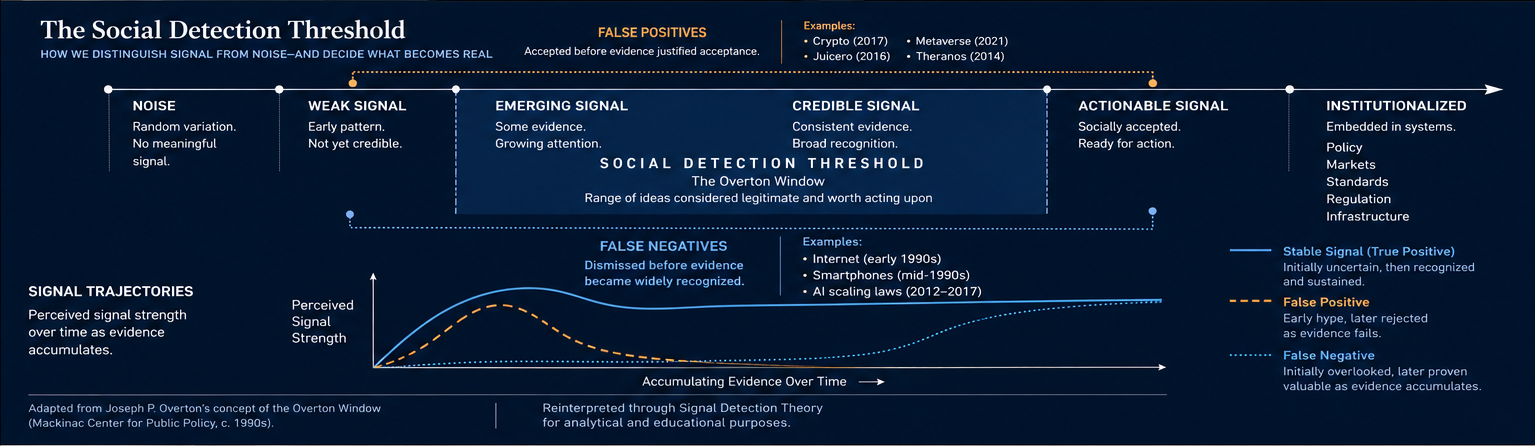
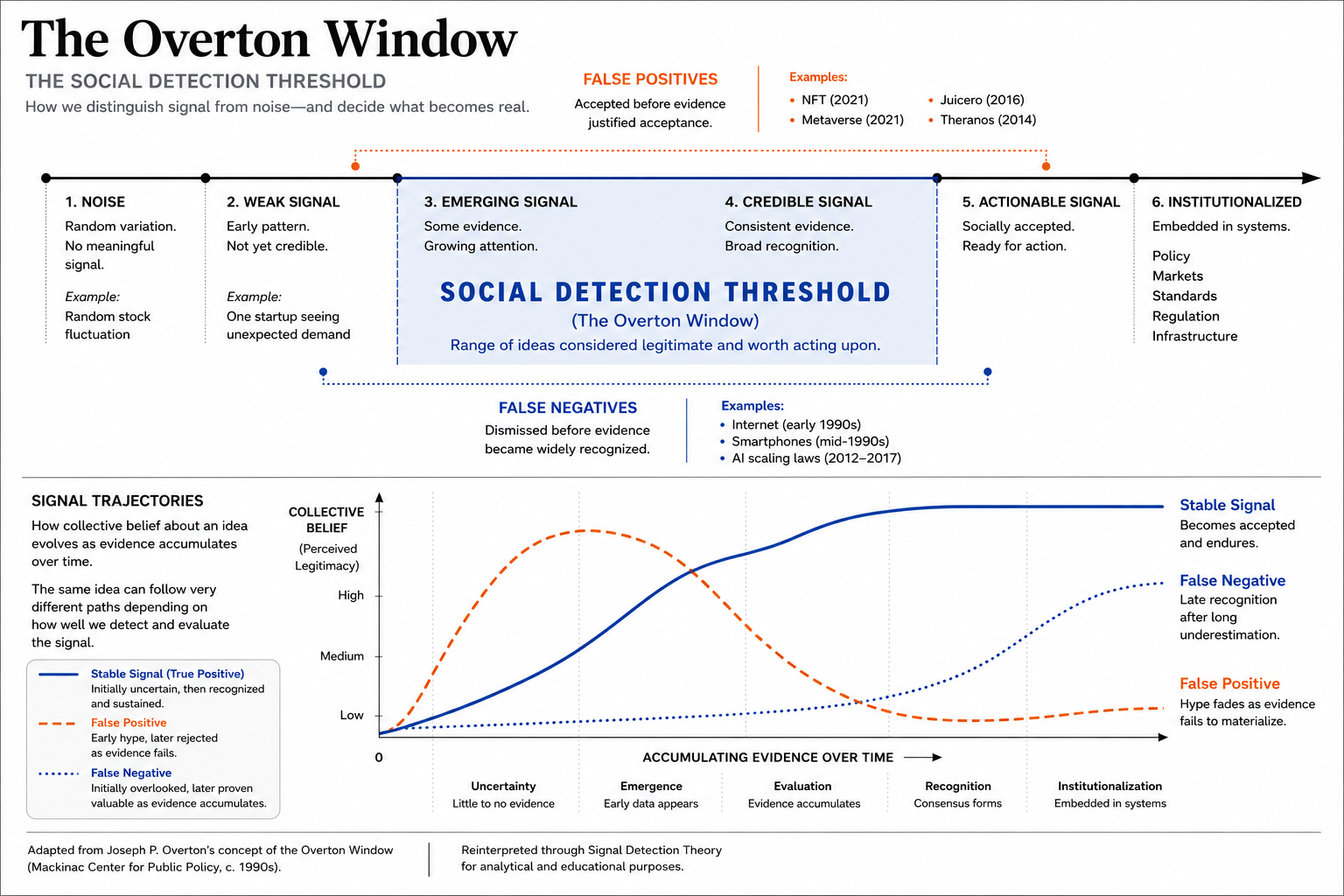
The fringe sits outside the window. A real trend is one that drags the window toward it. The error this paper is about is the quiet assumption that because something exists at the fringe, the window must already be moving to include it. Presence at the edge gets mistaken for momentum toward the center.
This is the logic under every bet in this paper. Each one caught something real at the fringe. Short mobile video was real. Spatial computing was real. Self balancing transport was real. A young, social, theater filling audience was real. The detection was correct every time. What failed was the second judgment, the one Webb insists on. Each organization assumed that because the signal was vivid and real at the edge, the window was already moving to receive it at scale. They confused the existence of the fringe with the momentum of the trend, and they funded the convergence before it had shown itself.
So the fringe is necessary, and the fringe is treacherous. Necessary because nothing important starts anywhere else. Treacherous because it looks the same whether it is about to move or about to die. A breakthrough that will define a decade and a novelty that will be forgotten in a year arrive at the edge with exactly the same intensity. The work begins at detection. It does not end there.
Two Tells That Foreclose the Test
The false positive has a sound. Learn to hear it and you have your first defense. The move from signal to conviction almost always runs through one phrase. This is the future. This changes everything. This is inevitable. The category is now established.
The phrase does not describe the world. It ends the argument about whether the reading is right. Section seven takes it apart word by word. Two tells matter first.
The first tell is a swap. The claim starts with a true statement about behavior, about what people are doing, which you can measure. Then it quietly switches to a claim about preference, about what people want, which is inferred and almost never measured. The behavior lends its credibility to the preference, and the preference is the thing that gets funded. A crowd showing up to something is real. The same crowd wanting a brand new category of that thing is a guess wearing the crowd's clothing.
The second tell is the source. A lot of what reaches a decision maker as a signal was produced by someone with a stake in how it gets read. The founder with a round to raise. The analyst with a position to defend. The platform measuring its own engagement. The report commissioned to confirm a conclusion already reached. None of this makes the observation false. It means the interpretation came pre attached, and the interpretation is the expensive part. A signal that arrives with its own conclusion is a signal to slow down.
These two tells show up at every size. The next sections trace them through one small product bet, one eighty billion dollar strategy, and five more in between.
A Hit, a Headline, and an Invented Category
In May 2026, Backrooms, a horror film directed by twenty year old Kane Parsons, opened to 81.4 million dollars in the United States. It was the biggest debut in A24's history, more than three times the studio's previous record.10 Sixty six percent of the audience was under twenty five. Forty four percent was under twenty one. A second film by another young director, Obsession, defied gravity at the box office in the same window. The facts were verified and they were remarkable. A generation the industry had written off as lost to streaming turned out to be the most frequent moviegoing audience in the country, showing up in groups, there for the shared experience.

Then a widely shared post compressed the whole thing into one sentence. Gen Z wants social cinema made by their peers, and this is the future.
It is worth being fair about that post. A marketer wrote it, and a marketer's job is to make a clean, confident claim that travels. This one did its job. The problem is not the person and it is not the enthusiasm. The problem is the logic underneath, because the sentence does three things at once, and only one of them is supported.
It names a product category, social cinema, that the data never described. It asserts a preference, wants, that nobody measured. And it seals the reading with the word future, which quietly removes the question of whether the reading is correct. A hope becomes an inevitability without passing through a single test.
Look at what the numbers actually support. Backrooms was an adaptation of a horror property that already had a devoted following online. The broader slate pulling Gen Z into theaters ran on video game adaptations and anime, on A Minecraft Movie, on Demon Slayer, on Five Nights at Freddy's. That is intellectual property and nostalgia. The director's age made a great story, but it was not the demand driver. The crowd came for the property. The peer authorship idea was the conclusion that got smuggled in next to the true observation, and it was the conclusion a venture would be built to chase.
This is the false positive at its cheapest. One founder, one thesis, a recoverable amount of money. It is worth studying precisely because it is small enough to see whole. The next section shows the same error when the organization making it has eighty billion dollars to spend.
The Same Sentence, Eighty Billion Dollars
In October 2021, Facebook renamed itself Meta around a conviction. Mark Zuckerberg called the metaverse the future, the place where people would work, shop, and play. The signal underneath was genuine. Immersive technology was advancing, the company had real assets, and there was a plausible case that the next computing platform would be spatial rather than flat. The reading was not absurd. It was a defensible interpretation of a real signal, turned into a settled conclusion by one sentence about the future.
Then the conviction got funded at a scale the film example cannot touch. Reality Labs, the metaverse division, posted operating losses that grew every year. Roughly 6.6 billion dollars in 2020. Then 10.2 billion. Then 13.7. Then 16.1. Then 17.7 billion in 2024 alone. Past eighty billion in cumulative losses by 2026.11 Horizon Worlds, the flagship world that was supposed to prove people wanted to live in this future, at one point drew fewer than a thousand daily users. The division produced about one percent of company revenue while it burned billions.
The market repriced the conviction long before the company admitted it. In early February 2022, the first full look at the spending triggered the worst single day in stock market history, erasing roughly 250 billion dollars of value in one session.12 Across that year, Meta lost most of its value. The punishment was not only for the losses. It was for the judgment, for the visible gap between how certain the conviction sounded and how absent the demand was.
The structure was identical to the film. A behavior was observable, technology advancing and a few early adopters engaging. A preference was assumed, that people wanted to live in virtual worlds, and never tested. The word future closed the question before eighty billion dollars moved against it. The conviction was an aspiration treated as a strategy. The real constraint, give people a reason to show up, was never named, so the money flowed at it without ever resolving it.
Then came the renaming, which is the third reliable feature of the false positive. The retreat is never an admission. Meta did not say the reading was wrong. It cut the budget, laid off Reality Labs staff, shifted the story toward wearables and AI glasses, kept much of the spend, and renamed the conviction so the original claim could quietly retire without ever being falsified. Watch for this in any thesis built on inevitability. When the promised future does not arrive, the claim does not die. It gets renamed into the thing the data supported all along.
Seven Bets, One Structure
The two cases above are not a matched pair I picked to make a point. They are two instances of a structure that shows up across every sector once you know what to look for. The bets below run from 2001 to 2026. Different people, different industries, different signals. Every one ran the same five beats. A real but thin signal. A behavior read as a preference. An inevitability frame that ended the argument. Capital committed before the demand was tested. And a renaming on the way out, so the thesis could retire without ever being called wrong.
Start with the oldest, because it is the most theatrical, and because the language around it has never been topped for sheer confidence.
In late 2000, before the public knew what it was, a self balancing scooter code named Ginger pulled the most powerful men in technology into open prophecy. Steve Jobs said it would be as big a deal as the personal computer. John Doerr, the venture capitalist behind Netscape and Amazon, went further and said it might be bigger than the internet, and predicted Segway would be the fastest company in history to reach a billion dollars in sales.1 Kamen himself supplied the vision the hype ran on. The Segway, he said, would be to the car what the car was to the horse and buggy, and he pictured cities from Seattle to Shanghai rebuilt around it.2 A book proposal leaked. Time put it on the cover under the title Reinventing the Wheel. The company built a factory sized to make forty thousand units a month.2
Read that again, because it is the inevitability fallacy in its purest form. The demand is never measured. It is assumed to be sitting there, latent, certain to appear the moment people simply see the thing. Doubt gets recast in advance as a failure to have seen. There is no test in it anywhere.
Here is the part the public quotes left out. Behind closed doors at a December 2001 meeting Doerr arranged at a San Francisco hotel, the same Steve Jobs who praised the device in the press told the room something else. I think it sucks. Its shape was not innovative, he said. It was not elegant. It did not feel anthropomorphic.3 The doubt existed. It was spoken by the most quoted believer in the room. It just never reached the public, because the public version was more useful to everyone with money in the deal. The hype was the product. The product was a scooter.

Kamen projected ten thousand units a week. By late 2003, about six thousand had sold in total. Roughly one hundred forty thousand ever sold across two decades before production ended.4 The signal was real. The convergence never came.
The pattern repeats with cleaner edges in four more.
Facebook reported soaring video watch time, and Zuckerberg promised a new golden age of video. Publishers believed it and laid off writers by the hundred to chase it. Mic, Vice, MTV News, Mashable, and Vocativ all gutted newsrooms or closed. Then the metric turned out to be disputed. A lawsuit alleged that average view time had been inflated by somewhere between 150 and 900 percent, and Facebook later settled with advertisers for forty million dollars while admitting no wrongdoing.5 The audience was never really watching. The traffic collapsed, often by sixty percent or more.
Mobile short form was clearly rising. The conviction was that it needed premium Hollywood production to grow up. Quibi raised 1.75 billion dollars before launch and burned through 1.4 billion of it in six months.13 The real demand was for free, user made, remixable video, and TikTok reached eight hundred million users in the same window on exactly the opposite model. The founders shut it down half a year after launch and admitted they never knew whether the idea or the timing was the problem.
Meta's conviction became everyone else's signal. Bob Chapek called the metaverse the next great storytelling frontier. Disney built a division, Microsoft formed a team, Walmart stood up a branded world. Within two years Disney dissolved its division inside a seven thousand person layoff, Walmart exited Roblox the same day, and Microsoft cut its metaverse team four months after forming it. Virtual land on Decentraland fell about eighty five percent.14
Subscribers grew from seven hundred thousand to three million while gyms were closed. A real, dramatic, honestly measured spike. The company read a temporary condition as a permanent shift and built capacity against it, including a four hundred million dollar factory. The spike was the lockdown, not a new normal. There was no fraud and no villain here, just a real number mistaken for a trend. Demand reverted, inventory ran from seventy days to two hundred and twenty five, the factory was canceled, and the stock fell roughly ninety five percent.15
Peloton deserves the closest look, because it is the version most likely to happen to you. No fraud, no villain. The spike was real and honestly measured. The error was purely in the reading, a temporary condition taken for a structural one, and the capital was committed before the reading was tested. This is the false positive in its purest form, and it does not require anyone to be lying. It only requires a real signal and the failure to ask what would have to be true for it to last.
What “This Is the Future” Actually Does
Now take the phrase apart, because it is the beam the whole structure rests on. Four words, four mechanisms, all firing at once.
Start with the verb. Is. Not might be, not could become, not is trending toward. Is. The present tense says the future is already settled and already known, which collapses the distance between a possibility and a fact. A futurist works in the conditional, in the range of what might happen under different conditions. The word is erases that conditional. It turns a forecast, which carries uncertainty by definition, into a description of something that has supposedly already happened. That slippage is the trick.
Then the article. The future, not a future. The definite article claims there is one future, this one, instead of a fan of possible futures shaped by choices not yet made. Foresight exists as a discipline precisely because the future is plural and contingent. The phrase denies the plurality. It tells you there is no other scenario to weigh, because the matter has already resolved to a single outcome. That is the opposite of foresight. It is foreclosure wearing foresight's clothes.
Third, the phrase performs a status move. To say this is the future is to position yourself as the one who can see it and the listener as the one who cannot yet. Disagreement gets recast, not as a different reading of the evidence, but as a failure of vision. The Segway hype did this perfectly. Doerr called it possibly bigger than the internet, and the press filled with cities rebuilt around a machine almost no one had ridden. The framing turns skepticism into blindness, which is why it works so well inside a room. It makes the act of questioning feel like the thing that needs explaining.

Fourth, and the reason it moves money so well, the phrase cannot be disproved by design. It points at a future that has not arrived, so nothing in the present can falsify it. It manufactures total conviction while offering nothing to test. By the time the future arrives and the claim can finally be checked, the capital is already committed and the other options are already gone.
Notice what the honest version costs the speaker. It trades certainty for accuracy. It admits the future is plural, that the belief might be wrong, and that there is evidence capable of disproving it. That is exactly why the dishonest version is more popular. Certainty raises money. Accuracy raises questions. The phrase this is the future survives, boardroom after boardroom, not because it is truer, but because it is more useful to the person who needs the check signed.
Four Tests Before the Check
The defense is not better signal detection. The signal was detected correctly in every case here. The defense is a gate between detecting a signal and funding a conviction. Four questions a thin pattern has to pass before it earns the right to move money. None of them slows the sensing. All of them slow the commitment, which is where the cost lives.
The four tests share one property. They do not ask whether the signal is real. They assume it is. They ask whether the conviction you are about to fund has earned the distance it is traveling beyond the signal. Every bet in this paper fails all four. The Segway failed the behavior preference gap and the falsification test, since no demand was ever measured behind the wonder. The pivot to video failed the falsification test and the source interest test at once, since the metric came from the party that needed it believed. Quibi failed the durable asset test. Peloton failed the behavior preference gap. Meta failed all four at a scale that took five years and eighty billion dollars to become undeniable. In every case the error was visible at the start, in the grammar of the claim, before any of the money moved.
- The signal itself, observed early
- The behavioral fact underneath it
- The narrative that converts it
- The confidence the narrative produces
- The headcount hired against it
- The capital committed to it
- The alternatives it forecloses
- The public reversal when it fails
The instinct to move fast on a fresh signal feels like foresight. It is usually the opposite. Foresight is the capacity to hold a real signal at arm's length long enough to ask what it has actually earned. The organization that acts decisively on every signal it detects is not more perceptive than its competitors. It is more exposed.
The sensing gap, the distance between what is happening and what reaches the decision maker in usable form, has a twin that gets far less attention. Call it the commitment gap, the distance between what a signal supports and what an organization decides it means. The first gap closes with better sensing. The second closes with better discipline. A practice that builds one without the other just detects false positives faster.
This is where the discipline pays. Alpha does not come from seeing the signal first. Everyone sees the signal now, because signal is cheap and everywhere. Alpha comes from reading it correctly while others are funding the misreading, and from keeping the capital those others are about to lose. The four tests are not caution for its own sake. They are the difference between the bet that compounds and the bet that becomes the next eighty billion dollar write down.
There is a harder question underneath all of this, and the four tests only begin to reach it. Every organization that funded these bets believed it was acting on strong evidence. The failure was not low confidence. It was confidence that felt earned and was not. Knowing where you actually sit, rather than where you feel you sit, is its own discipline, and a later paper takes it up.
Detect quickly. Commit slowly. The missed signal costs an opportunity. The false positive costs the firm. Those two errors are not the same size, and no serious practice should treat them as if they were.
- 1Time, "Reinventing the Wheel," John Heilemann, December 2, 2001. Steve Jobs ("as big a deal as the PC"), John Doerr ("bigger than the internet," "fastest outfit in history to reach a billion dollars in sales"). https://content.time.com/time/business/article/0,8599,186660,00.html
- 2Time, "Reinventing the Wheel" (full feature), December 2, 2001. Dean Kamen ("to the car what the car was to the horse and buggy," Seattle to Shanghai), the transportation industry framing, the forty thousand units per month factory. https://time.com/archive/6905012/reinventing-the-wheel-3/
- 3Steve Kemper, Code Name Ginger, excerpted by Harvard Business School Working Knowledge, 2003. The December 2001 meeting and Steve Jobs ("I think it sucks" and the design critique). https://hbswk.hbs.edu/archive/3533
- 4Time, "The 10 Biggest Tech Failures of the Last Decade," 2009. The development cost, the production projection, and the actual sales figures. https://content.time.com/time/specials/packages/article/0,28804,1898610_1898625_1898641,00.html
- 5Fortune, October 7, 2019; CBS News, October 2018. The metric inflation allegation (150 to 900 percent is the plaintiffs’ claim) and the forty million dollar settlement with no admission of wrongdoing. https://fortune.com/2019/10/07/facebook-lawsuit-settlement-inflated-video-data-advertisers/
- 6Marketing Dive, February 28, 2022; Digiday, January 2023. The holding company metaverse practices and the Publicis framing. https://www.marketingdive.com/news/agencies-metaverse-practices-ramp-up-in-preparation-for-new-digital-age/619428/
- 7LBBOnline and Retail Technology Innovation Hub, September 2022. Walmart Land built by Walmart’s agencies (Publicis Groupe and the consultancy Journey). https://lbbonline.com/news/walmart-jumps-into-roblox-with-walmart-land-and-walmarts-universe-of-play
- 8Amy Webb, The Signals Are Talking: Why Today’s Fringe Is Tomorrow’s Mainstream. PublicAffairs, 2016. The fringe to mainstream model and the distinction between a real trend and the merely trendy, drawn throughout this section. https://www.hachettebookgroup.com/titles/amy-webb/the-signals-are-talking/9781610396677/
- 9The Overton Window, Mackinac Center for Public Policy. The origin of the concept with Joseph P. Overton in the mid 1990s, and the model of how the acceptable range shifts over time. https://www.mackinac.org/OvertonWindow
- 10Box office reporting, May 2026. Backrooms opening of 81.4 million dollars, A24 record, and the audience age breakdown. https://www.boxofficemojo.com/
- 11Meta Platforms annual and quarterly filings, Reality Labs segment, 2020 to 2025. The year by year Reality Labs operating losses and the cumulative figure past eighty billion dollars. https://investor.atmeta.com/
- 12Reuters and Associated Press, February 3, 2022. The single day decline of roughly 250 billion dollars in Meta market value. https://www.reuters.com/technology/meta-loses-200-billion-market-value-2022-02-03/
- 13The Wall Street Journal and Variety, October 2020. Quibi raising 1.75 billion dollars and shutting down roughly six months after launch. https://variety.com/2020/digital/news/quibi-shutting-down-1234805746/
- 14CNBC and Reuters, 2023. The Disney, Microsoft, and Walmart metaverse retreats, and the decline in Decentraland virtual land values. https://www.cnbc.com/2023/03/28/disney-shuts-metaverse-division-as-part-of-restructuring.html
- 15CNBC, May 2022. Peloton subscriber growth, inventory build, factory cancellation, and the stock decline. https://www.cnbc.com/2022/05/10/peloton-pton-q3-2022-earnings.html
Working Paper · Vol. 1 · No. 5 · Signal Detection · Decision Quality · Capital Discipline