ForesightOps Insights · Companion to the Spring 2026 Quarterly

    Is It
    Worth It?

    The quiet question parents are asking this spring, and a one-page rubric for the bet on the kitchen counter.

    What a loaded question. Pregnant with hidden assumptions.

    There is a quiet question parents are asking themselves this spring. Most are not posting it on Facebook, or LinkedIn. They are asking it in the car on the way home from the campus tour. Is this worth it?

    My honest answer is that the people who should know are not sure either. Toby Stuart, who teaches strategy at UC Berkeley Haas and writes regularly on the workforce implications of AI, has published two pieces this past year that take the question seriously.

    In Time, he writes:1

    "Regardless of the long-term impact of AI, our education system needs urgent reform. Our current system trains humans to do what AI does best: process information, follow rules, produce standardized outputs. In that case, universities are currently fine-tuning their students for obsolescence, and the latter are paying handsomely for this privilege."
    Toby Stuart · Time, September 2025

    Read that twice. He is saying the kid you are about to send to college may be paying premium tuition to be trained for the work AI is best at.

    In Harvard Business Review, he sharpens the critique:2

    "Consider education, which is the largest long-duration investment many of us make. We commit years and take on substantial debt for college and advanced degrees and the opportunity to step onto a career ladder with predictable rungs. If you are young and ambitious, you might invest in an expensive medical degree in return for the 30- to 40-year income of a rewarding, high-earning career. Or enroll in an MBA program to sharpen your analytical and managerial skills for a decades-long career leading a P&L. These are bets on the long-term value of human capital."
    The Same Months. Three Defensible Readings.
    9.3M
    US jobs at risk of AI displacement, central estimate
    Flat
    unemployment in AI-exposed occupations, observed
    22–25
    cohort hiring slowed sharply in highly exposed fields

    Last month we published the Spring 2026 Quarterly on the AI panic parents are feeling about their kids' careers, and what the research actually shows once you cut through the hype. Three top teams are reading the same months of 2026 and reaching three different conclusions. Tufts says nine point three million US jobs are at risk.3 Yale says actual unemployment in those occupations is essentially flat.4 Anthropic finds hiring of twenty-two to twenty-five year-olds slowed sharply.5 None of them is wrong. They are looking at different parts of the same change.

    Stuart's HBR argument turns on a distinction the economist Frank Knight made a hundred years ago.6 Risk is quantifiable. You can assign probabilities. You can price the bet. Uncertainty is the condition where the probability distribution itself is unknown. The radiologist finishing residency in 2035 sits somewhere on a curve that runs from completely indispensable to obsolete, and nobody can tell you the odds. That is not risk. That is uncertainty.

    II
    Where Stuart Lands

    Optionality Is the Principle.
    The Rubric Is How You Practice It.

    Stuart's prescription is optionality. Stage your bets. Reskill often. Hold your professional identity loosely, guard your reputation, invest in the network. Build the ability to abandon a plan you have already invested in.

    I agree with all of it. Here is where I want to push.

    Optionality is a beautiful principle. It is also abstract. It does not tell a parent on a Tuesday night what to do with the three acceptance letters on the kitchen counter. One hundred eighty thousand dollars of debt for a journalism program at a private university. The in-state public offer with a paid co-op into nursing. A year deferred to apprentice through the local electrical union. Each of those is a specific bet, with a specific cost, with a specific shape of regret if it goes wrong.

    That family does not need more theory. They need a tool to think it through. So we designed one.

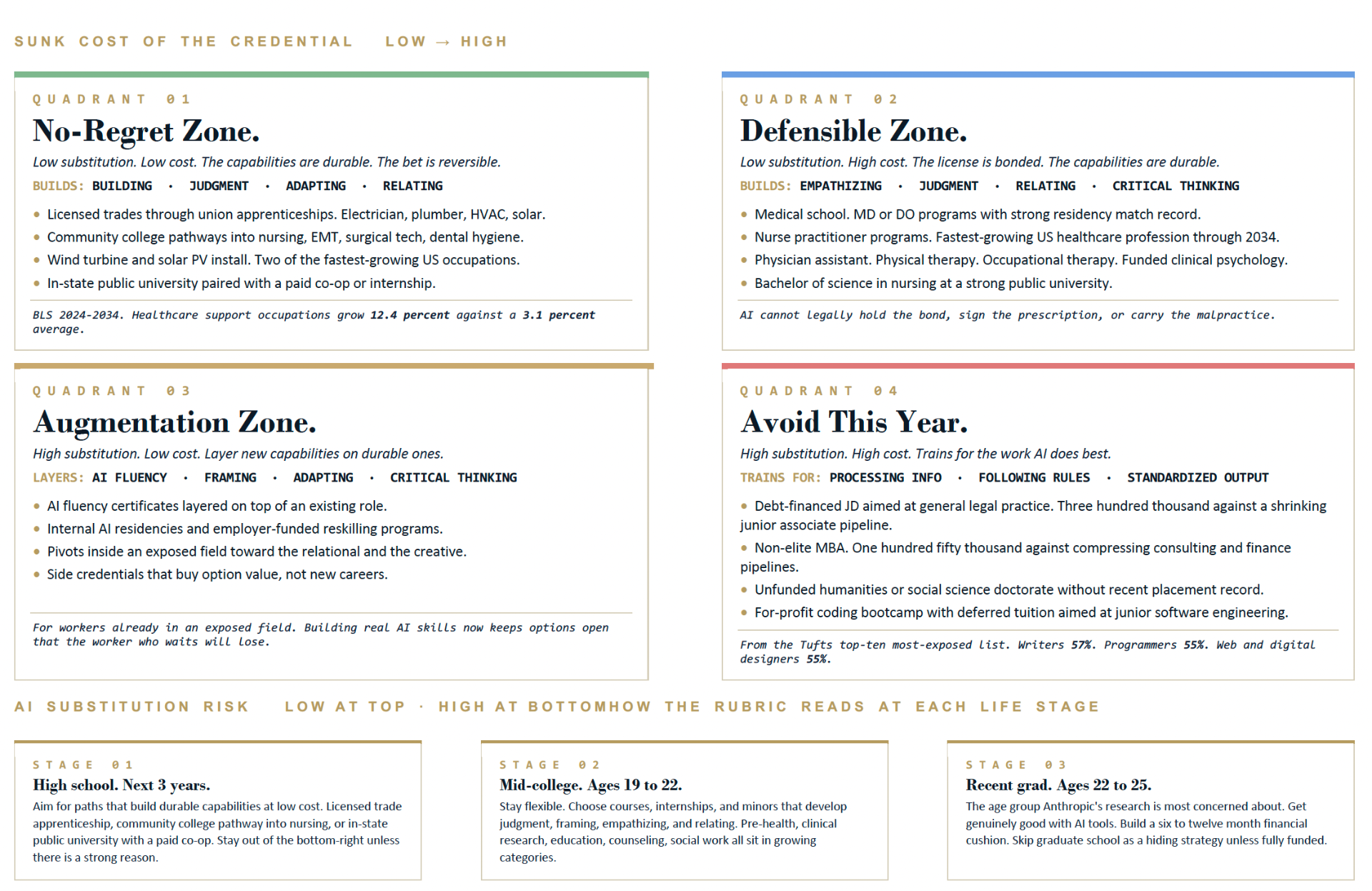
    Family Career Bet · Two Axes · Four Quadrants
    The Family Career Bet Rubric — four quadrants (No-Regret, Defensible, Augmentation, Avoid This Year) plotted against AI substitution risk and sunk cost of credential, with three life-stage reads beneath.

    The Family Career Bet Rubric is a simple two-by-two grid that maps any specific career bet against two questions a parent can actually answer. How easily could AI do the work itself. How costly is the credential, and how hard would it be to walk away from. Plot the bet. Read the quadrant. Test the reversibility. Match it to the life stage of the kid at the table.

    That is what optionality looks like when it gets specific.

    What the Rubric Does
    The rubric does not predict which bet wins. It makes the cost of each bet visible before the bet is made. That is what families need right now. Not predictions. Decision support that holds up under uncertainty.

    The journalism program lands in Quadrant 04. High AI substitution risk. High sunk cost. Hard to walk back. The nursing program lands in Quadrant 01. Low substitution risk. Low sunk cost. Easy to adapt. The apprenticeship also lands in Quadrant 01, with a different timeline and a different income curve. The data anchors are explicit: BLS 2024–2034 Employment Projections,7 Tufts AI Jobs Risk Index,3 Anthropic Economic Index for the cohort effect.5

    Spring 2026 · The Companion Set

    The rubric for the kitchen table, and the issue underneath it.

    One page you can print and hold in one hand. The Quarterly that gives it the data and the cadence. The Four Futures companion that gives it the rehearsal.

    ·

    Read both Stuart pieces. They are solid and serious work. Then come back, plot the bet your family is making, and have the conversation. Optionality is the principle. The rubric is how you practice it.

    And if you want the synthesis at altitude — the three anomalies, the four threat models, the six moves designed to hold across all of them — the Spring Quarterly is the place to start. Read The Signal Beneath the Hysteria →

    William Haas Evans
    Founder, ForesightOps. Principal, Fugue Strategy Advisors. Three decades inside the constraint between strategy and execution. The Family Career Bet Rubric is part of the Spring 2026 Quarterly companion set.
    References
    1 Stuart, T. (2025). The Philosophical Bet We All Need to Make in the Age of AI. Time, September 29, 2025.
    2 Stuart, T. E. (2026). The Future Is Shrouded in an AI Fog. Harvard Business Review, April 27, 2026.
    3 Tufts Digital Planet (2026). American AI Jobs Risk Index. Released March 24, 2026.
    4 Yale Budget Lab (2026). AI Labor Market Tracker. Released February 2, 2026.
    5 Anthropic (2026). Labor Market Impacts of AI, March 5, 2026, and the Anthropic Economic Index March 2026 report.
    6 Knight, F. H. (1921). Risk, Uncertainty, and Profit. Houghton Mifflin. The foundational distinction between measurable risk and unmeasurable uncertainty.
    7 US Bureau of Labor Statistics (2025). Employment Projections, 2024–2034.
    8 Gecker, J. and Sanders, L. (2026). "College students are changing course in search of AI-proof majors." Associated Press, April 27, 2026.
    9 Evans, W. H. (2026). The Signal Beneath the Hysteria. ForesightOps Spring 2026 Quarterly, May 1, 2026.